


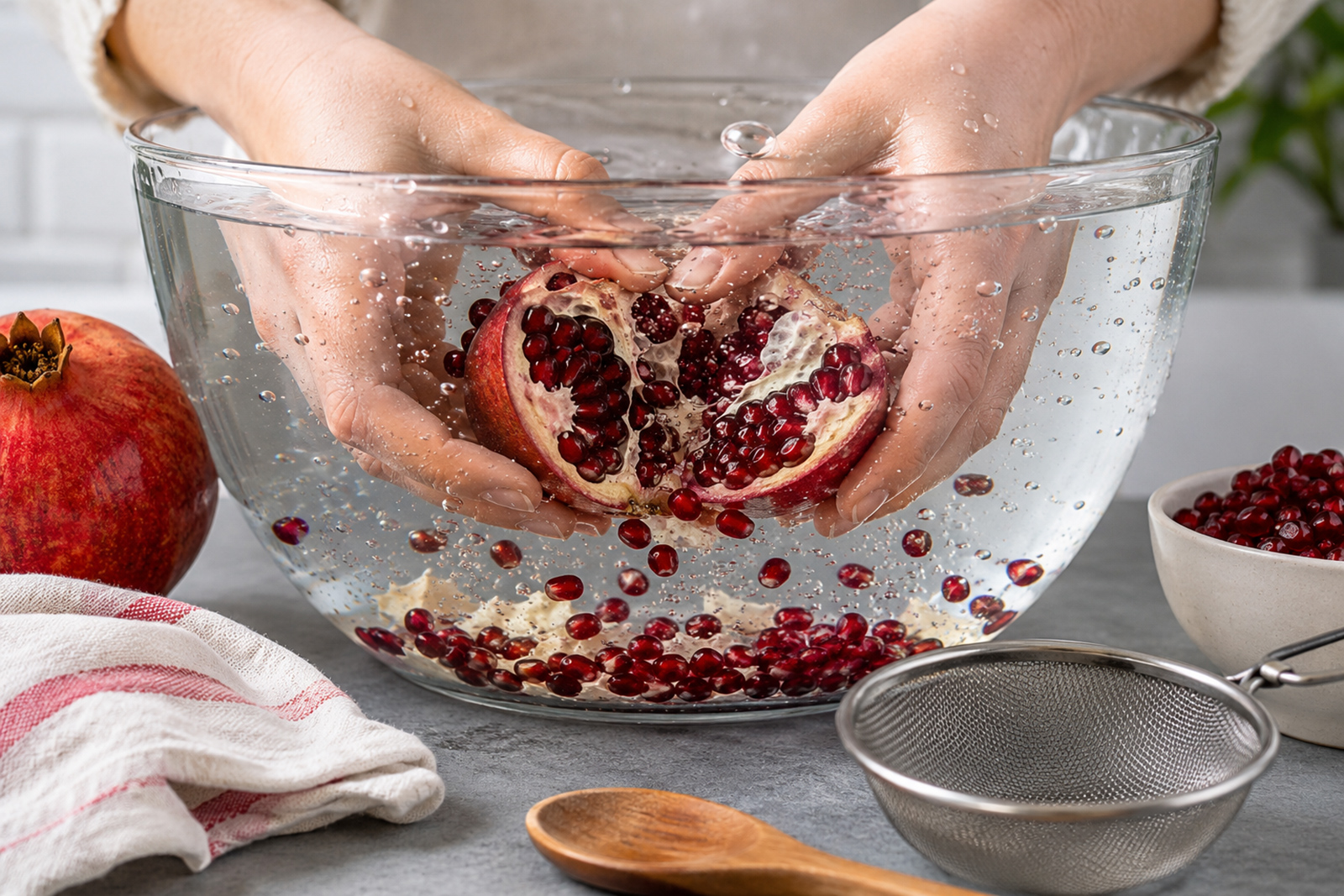
As much as we love the ruby fruit, pomegranate juice stains fast, and it stains just about everything: countertops, cutting boards, your favorite white shirt. If you’ve ever Googled how to open a pomegranate after a juice splatter incident, you’re not alone.
The good news: there’s a reliable, low-mess way to do this that doesn’t require a special gadget or a steady hand with a paring knife. It just requires water.
This guide walks through the underwater method start to finish, why it works, and what to do if you don’t have a free sink.
Why the underwater method works
Pomegranate juice stains because the arils (pomegranate seeds) rupture on contact with a blade or fingernail, and the juice sprays. Submerging the fruit in water contains that spray before it ever reaches your clothes or counter.
The water also does double duty: the white pith floats, and the arils sink. Once you’ve broken the fruit apart underwater, separating the arils from the pith becomes a matter of skimming rather than picking.
This is the same principle behind most “no mess” pomegranate hacks circulating on social platforms. The water bath isn’t a shortcut; it's the mechanism.
Step-by-step: opening a pomegranate in water
Fill a large bowl with enough cold water to fully submerge the fruit.
Score the pomegranate around its equator with a knife, cutting through the rind only, not deep into the fruit.
Break the pomegranate into halves with your hands while it’s still above the bowl, then transfer both halves into the water.
Work underwater: use your thumbs to pry the arils loose from the white pith, section by section. The pith floats to the surface, and the arils drop to the bottom.
Once you’ve worked through both halves, skim off the floating pith and drain the water through a colander to catch the arils.
Pat the arils dry and refrigerate them, or eat them right away.
Opening a pomegranate without a knife
A knife makes scoring faster, but it isn’t required. Pomegranates have a natural seam pattern on the rind, visible as faint ridges running from stem to base.
Pressing your thumbs into these seams and pulling gently will crack most ripe pomegranates open by hand. This works best on fruit that’s fully ripe, since the rind softens slightly as it matures.
If the rind resists, a few taps against a hard surface (still above the water bowl, to catch any early splitting) will usually loosen it enough to pull apart by hand.
Do deseeding gadgets work?
Pomegranate deseeder tools and gadgets have picked up real interest online, even though they’re not yet a high-volume search term. Most work by pressing the halved fruit through a grid or against a rotating extractor.
Results vary by fruit size and ripeness, and a mismatched tool can crush arils along with the pith, which defeats the purpose. If you already have one, use it over a bowl of water for the same spray-containment benefit as the hand method.
Either approach gets the job done. Pick whichever fits your kitchen and your patience level.
Why water is the only tool you need
The underwater method turns a notoriously messy fruit into a five-minute kitchen task: no special tools, no stained countertops. Once the arils are separated, they’re ready for snacking, salads, or a glass of POM Wonderful® 100% Pomegranate Juice alongside them.
Need the fast version without the full walkthrough? Drink to your health, and check the quick-reference guide below for the shorthand steps.
FAQ
Is the underwater method really mess-free? It dramatically reduces spray and staining risk, though a fully ripe pomegranate can still leak juice once the rind is scored. Working over a bowl catches the vast majority of it.
What if I don’t have a big enough bowl? A clean kitchen sink works the same way. Plug the drain, fill the sink with a few inches of cold water, and follow the same steps.
Will this method work on an underripe pomegranate? Underripe fruit is harder to break apart by hand, and the arils release less easily from the pith. A ripe pomegranate feels heavy for its size and has taut, slightly flattened-looking skin.